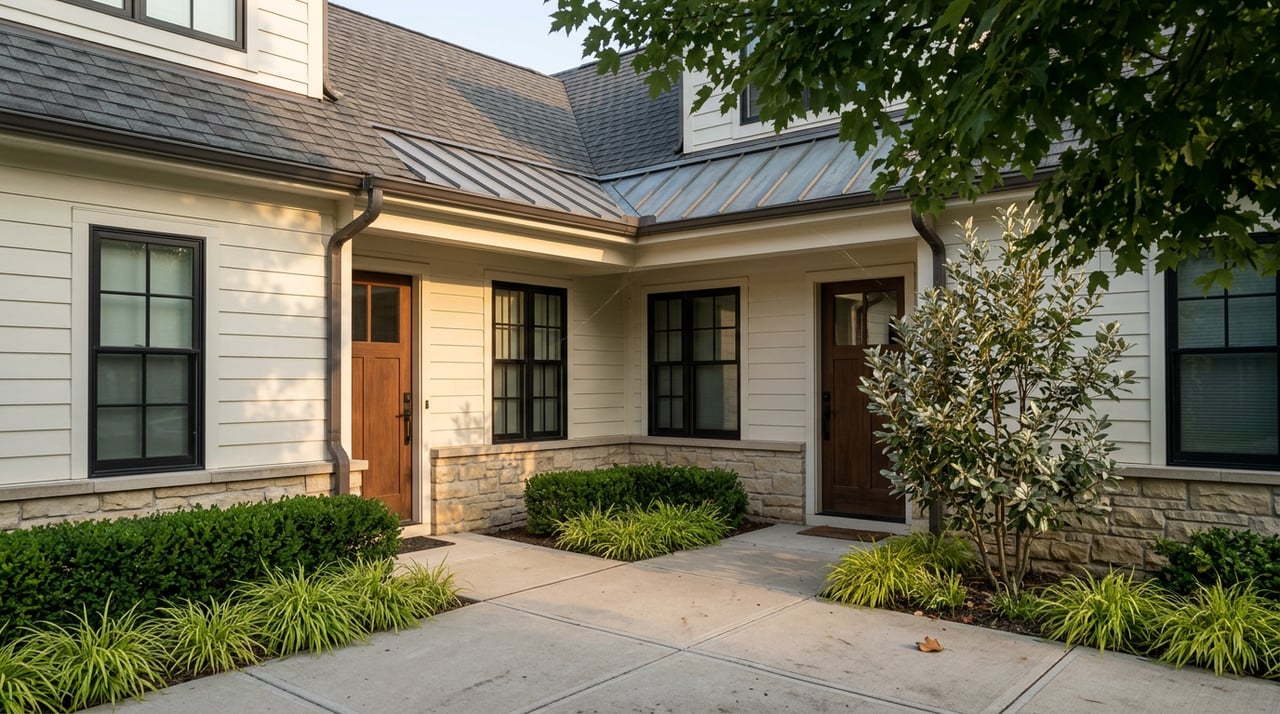
Woodcliff Lake's Median Price Jumped 56 Percent. Nine Townhomes Explain Most of the Number.
August 20, 2026
August 20, 2026
A three-bedroom townhome at 188 Broadway in Woodcliff Lake comes with a private elevator to all three levels, Thermador appliances, a waterfall quartz island, and something most buyers in this town have never had to think about: a five-year property tax abatement worth an estimated $75,000. It sits directly across the street from the Woodcliff Lake train station on NJ Transit's Pascack Valley Line. It is one of just nine units in a small development called Lexington on Broadway, and depending on which unit and which month, it has listed anywhere from roughly $1.25 million to $1.47 million.
That single address is doing more work in this town's headline housing statistics than almost anyone realizes.
If you pulled up Woodcliff Lake's housing data recently, you likely saw something like this: median sale price of $1.3 million for the three months ending May 2026, up 56.2 percent from the same period a year earlier. Days on market nearly doubled, from 63 days a year ago to 107 days now. Sixteen homes sold in May 2026, compared with six in May 2025.
Read at face value, that is a confusing story. Prices are supposedly surging at a pace few Bergen County towns have seen, yet homes are also taking far longer to sell. Those two trends do not usually move together. A market that is genuinely getting more expensive, more competitive, tends to move faster, not slower.
The explanation is not that Woodcliff Lake's housing market broke some rule of economics. It is that Woodcliff Lake is a small town, and a small handful of new-construction sales can move a median more than most buyers or sellers expect.
Woodcliff Lake has roughly 2,000 residential properties total. A monthly sales count of six to sixteen homes is not a statistically deep pool. When a development like Lexington on Broadway starts closing units in the $1.25 million to $1.47 million range, alongside the town's usual mix of colonials, split-levels, and ranches, it does not just add to the average. It can single-handedly shift where the middle of the list falls.
RVN Enterprises is the construction manager behind the project, built across two small buildings, one with five units and one with four, at 188 Broadway. The units are priced well above what a typical resale colonial has fetched in Woodcliff Lake historically, and they come bundled with an incentive that has nothing to do with the house itself: a five-year municipal tax abatement estimated at $75,000 in savings, meaning buyers do not pay full property taxes on the improvement for the first five years of ownership.
That abatement matters for two reasons. First, it changes the real monthly cost math for a buyer in a way a sale price alone does not capture. A $1.3 million townhome with reduced taxes for five years carries differently than a $1.3 million resale home paying full freight from day one. Second, it is a strong incentive for a builder to move inventory quickly, which is exactly what you would expect to see reflected in sales counts during the months those units close.
MLS records tied to the project stretch back to spring 2025, when the first units listed, and new MLS numbers for individual units at 188 Broadway were still being generated as recently as June 2026, some accompanied by promotional offers like a three-month HOA credit. A newly furnished model unit was open to buyers as of mid-2026. That is over a year of active marketing for a nine-unit project, which tells you something about absorption pace that a single month's median cannot.
A town that sells six to sixteen homes a month does not need very many new-construction closings to make its median look like a different market entirely.
The rest of Woodcliff Lake's active inventory as of mid-July 2026 tells a more familiar story. A six-bedroom home on Heatherhill Lane listed at $1,239,000. A four-bedroom on the same street listed at $1,099,000. A three-bedroom on Shaw Road came in at $1,035,000. A larger five-bedroom estate on Blueberry Drive listed at $2,299,000, reflecting the kind of larger, established-lot property that has always existed at the top of this market.
| Segment | Example location | Listed price | What it represents |
|---|---|---|---|
| New construction townhome | Lexington on Broadway, 188 Broadway | roughly $1.25M–$1.47M | New build, tax abatement, train-station adjacency |
| Established single-family resale | Heatherhill Lane | $1,099,000–$1,239,000 | Traditional colonial-era housing stock |
| Established single-family resale | Shaw Road | $1,035,000 | Mid-range existing home |
| Larger executive resale | Blueberry Drive | $2,299,000 | Larger lot, top of the established market |
Line these up next to the Broadway townhomes and the spread is obvious. A buyer comparing a $1.1 million colonial on Heatherhill Lane to a $1.3 million new-construction unit at Lexington on Broadway is not comparing two versions of the same product. One is decades-old housing stock on a residential street. The other is a brand-new, tax-advantaged unit steps from a commuter rail platform. Folding both into one median and calling it "the Woodcliff Lake market" flattens a distinction that actually matters to what you should expect to pay, or list for, on your own street.
Here is where it gets more interesting for anyone trying to use these statistics to make a decision. Redfin's figure of 107 average days on market is measured one way. Other sources tracking recently sold homes in the same town, over overlapping windows, have reported average days on market closer to 34 to 36 days. A separate measure of active listing time from another source put it at 25 days.
Those are not small rounding differences. They are different methodologies producing wildly different pictures of the same town in the same stretch of 2026. Some measure time from list to accepted offer. Others measure list to closing. Some sit as trailing three-month windows, others as trailing twelve. In a market with dozens of sales a month, those methodology gaps average out and barely matter. In a market with single digits to low double digits of monthly sales, one long-sitting new-construction listing can drag an average up by weeks on its own.
That is very likely what is happening here. A handful of Lexington on Broadway units carrying MLS histories stretching back well over a year, still marketed with incentives in mid-2026, would pull a sold-time average upward in exactly the way Redfin's figure shows, even while a typical resale colonial in town is still moving in a more ordinary five to six weeks.
Separately, trailing twelve-month figures from other sources tell a calmer story than the three-month sold median. One index put Woodcliff Lake's typical home value at roughly $1.29 million, up 7.2 percent over the past year. Another put the trailing twelve-month median in the $1.1 million to $1.2 million range, growth in the high single digits to low double digits. Those numbers are a far cry from 56 percent, and they are likely a better read on what a typical existing home in town has actually appreciated, since they smooth over a single project's closing schedule rather than reacting to it month to month.
If you own an existing single-family home in Woodcliff Lake and you saw the 56 percent headline, do not assume your home just got dramatically more valuable overnight. That number is disproportionately a reflection of nine new townhomes selling at a price point most of the town's existing stock has never approached, combined with an abatement structure unique to that project. Your actual comp set is streets like Heatherhill Lane, Shaw Road, and Blueberry Drive, not the Broadway new-construction cohort.
If you are a buyer weighing new construction against resale, the tax abatement is worth running the numbers on directly rather than folding it into a simple price comparison. Five years of reduced property taxes changes the monthly math in a way that a sale price alone will not show you, and it is the kind of detail that only shows up when you look past the median into what is actually closing.
If you are comparing Woodcliff Lake to a neighboring Bergen County town using a portal's headline stat, ask what window that figure covers and how many sales sit behind it. A three-month median in a town this size is vulnerable to exactly the kind of distortion Lexington on Broadway is producing right now. A trailing twelve-month figure, while less dramatic, is the steadier signal.
Does the tax abatement at Lexington on Broadway transfer to a future buyer if I purchase a resale unit later? Abatement terms are set by the municipality and tied to the specific property and improvement, so any buyer should confirm the remaining term and conditions directly with the borough before assuming the full five years carries forward with a resale purchase.
Is the new construction at 188 Broadway limited to for-sale townhomes? No. The same site includes a separate project converting a former office building into a 37-unit multifamily rental building, which does not factor into the for-sale median but is worth knowing about if you are evaluating the corridor as an investor or landlord.
Should I expect my Woodcliff Lake home to now appraise closer to the $1.3 million headline median? Not automatically. An appraisal will lean on comparable sales of similar vintage, size, and condition. A decades-old colonial and a brand-new, tax-abated townhome across from the train station are unlikely to be treated as direct comps by an appraiser, even though both currently count toward the same town-wide statistic.
Numbers like these are exactly why a town-wide median is a starting point, not a conclusion. If you are trying to figure out what your specific home is actually worth in this market, or how to read a comparable town's statistics with the same scrutiny, the Stacy Esser Group can walk through the real comp set with you. Schedule a meeting today.
Stay up to date on the latest real estate trends.


SEG is a high performing Bergen County luxury real estate team that blends relationship driven service, cutting edge marketing, and strategic negotiation to consistently outperform traditional agents.